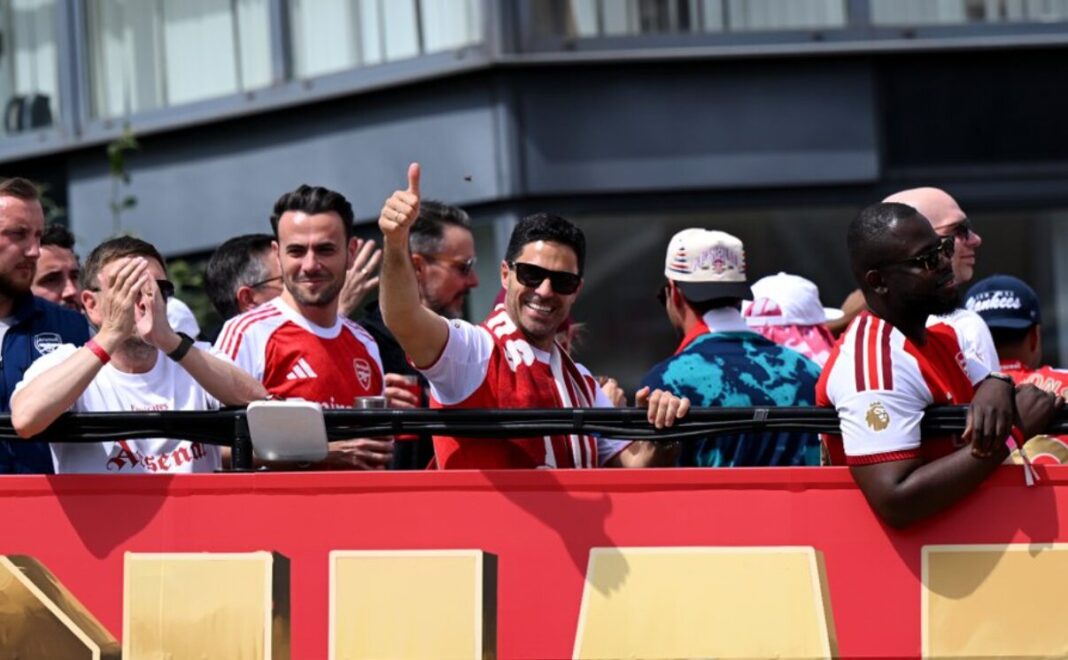
Football has a strange, beautiful way of balancing the ledger of human emotion. On a Saturday night in May, the red half of North London lay awake in quiet heartbreak, processing a painful defeat to Paris Saint-Germain in the Champions League final. Yet less than twenty-four hours later, the streets of Islington were transformed into a sprawling, chaotic sea of euphoria.
Hundreds of thousands of supporters packed every available inch of a 5.6-mile parade route circulating the Emirates Stadium. The European disappointment did not dampen the atmosphere. Instead, it was completely swallowed whole by a collective release of tension twenty-two years in the making. Arsenal are the champions of England once again, and no amount of continental heartbreak could diminish the magnitude of what this football club has just achieved.
The parade was not just a celebration of a trophy; it was a celebration of survival, patience, and eventual dominance. For the first time since the legendary Invincibles of the 2003/04 campaign, the Premier League trophy has returned to its rightful home in this corner of the capital.
A Final Day Journey to Glory
The definitive moment of this historic campaign arrived on May 24, a afternoon laden with tension that eventually gave way to pure celebration. Facing Crystal Palace, Arsenal needed to put the final stamp on an extraordinary domestic crusade. The resulting 2-1 victory was a microcosm of their entire season: disciplined, resilient, and utterly clinical when the stakes were highest.
When the final whistle blew, it finalized a league table that few could have predicted for its sheer margin of comfort. The Gunners finished the season on 85 points, standing a massive seven points clear of Pep Guardiola’s Manchester City. In a league where titles are routinely decided by millimeter margins and single points on the final day, Mikel Arteta’s men turned the final weeks of the season into a procession.
This was not a title won by the skin of their teeth. This was a systematic dismantling of the rest of the top flight, proving that the gap between Arsenal and the chasing pack has swung definitively in favor of London.
The Steel Behind the Silverware
While English football often romanticizes free-flowing attacking play, Arteta built his masterpiece from the back. To understand why this team succeeded where previous iterations stumbled, one only needs to look at the defensive metrics. Arsenal conceded a mere 27 goals over the course of the grueling 38-game calendar, anchoring themselves as the absolute best defensive unit in the country.
At the heart of this suffocating backline was David Raya. The Spanish goalkeeper enjoyed a truly historic individual campaign, securing his third consecutive Golden Glove award. By keeping 19 clean sheets, Raya provided the ultimate security blanket for a team that refused to beat themselves.
Tactically, the manager perfected a system of total control. The defensive structure operated like a suffocating web, denying opponents space in transition and strangling games once Arsenal took the lead. The defensive solidity shifted the entire psychological profile of the club. The fragility that haunted past Arsenal squads has been entirely erased, replaced by an ironclad belief that if the opposition cannot score, they cannot win.
Banishing Two Decades of Ghosts
The sheer weight of the 22-year drought has hung over the Emirates Stadium like an invisible anchor for two decades. Generation after generation of talented squads threatened to break the curse, only to crumble under the shadow of Arsene Wenger’s unbeaten icons. By finally crossing the finish line, this group of players has written their own history, completely independent of the past.
For Arteta, this title represents the ultimate validation of his project. It marks his fourth major trophy in seven years at the helm, a tenure defined by initial skepticism that has now yielded absolute adoration. The manager has endured immense pressure, squad overhauls, and agonizing near-misses, but his vision has culminated in the ultimate domestic prize.
The scenes during the 5.6-mile procession highlighted a profound connection between the team and its community. The electric fan vibes, the historic turnout, and the sheer volume of humanity clogging the streets of Islington served as a reminder of what this club means to its people. It was a shared exorcism of two decades of footballing frustration.
A New Era of Domestic Dominance
What matters most now is how this triumph alters the landscape of English football going forward. For years, Manchester City maintained an iron grip on the Premier League trophy, creating an aura of invincibility that left the rest of the league fighting for scraps. By finishing seven points ahead of the reigning champions, Arsenal have shattered that myth entirely.
The disappointment of the Champions League final loss to PSG will linger in the short term, but the broader picture suggests this is a team built for a sustained era of success. They possess the youngest core among Europe’s elite, a tactical blueprint that modern attackers find impossible to break down, and a manager who has now tasted the ultimate domestic success.
As the parade buses finally rolled away and the clean-up began on the streets of Islington, the message sent to the rest of Europe was loud and clear. Arsenal are no longer the bridesmaids, nor are they a young team full of potential. They are the defensive titans of England, the undisputed champions, and they are here to stay.

