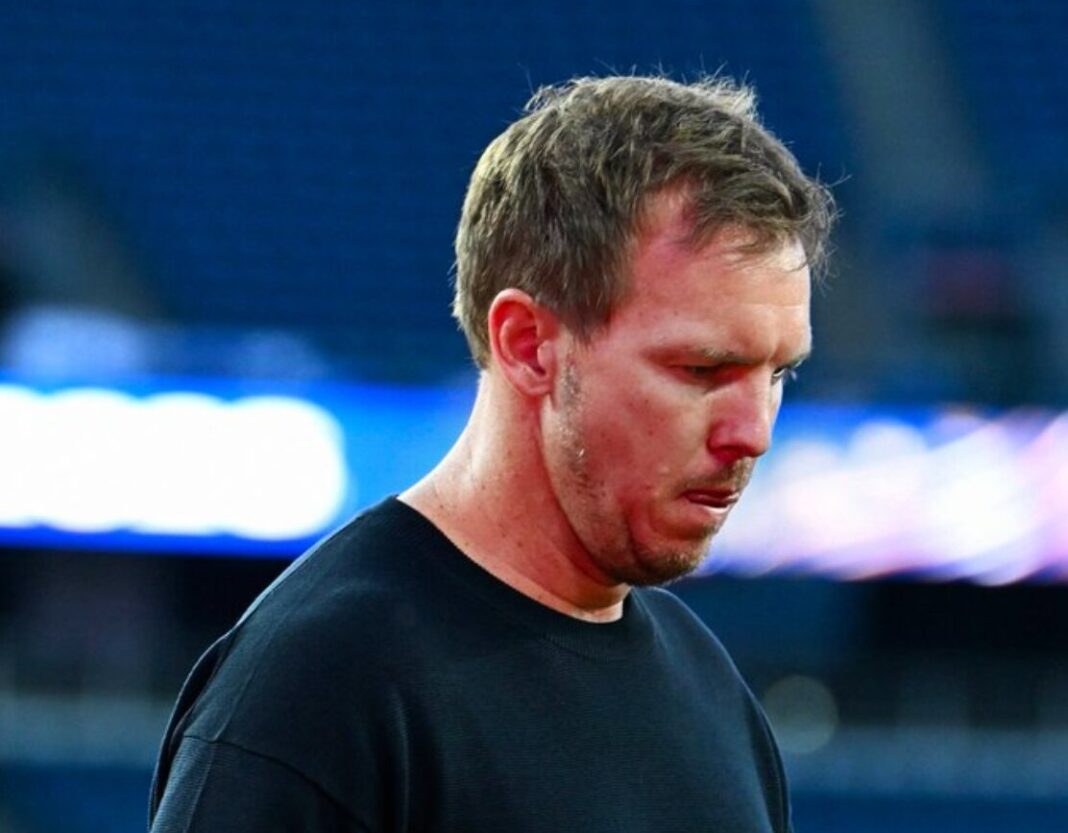
The pressure surrounding Julian Nagelsmann has reached a critical stage, with Germany’s football leadership now facing one of its biggest decisions in recent years.
According to reports, the German Football Association has advised Nagelsmann to consider stepping down following Germany’s disappointing FIFA World Cup campaign. While he technically remains in charge for now, the situation appears increasingly uncertain. Should the 39-year-old choose not to resign, the current plan is reportedly to dismiss him, although a final decision has yet to be made.
For the moment, Nagelsmann remains Germany’s head coach. However, the coming days could determine not only his future but also the direction of one of international football’s most decorated national teams.
World Cup Failure Brings Long-Simmering Questions to the Surface
Germany’s latest World Cup campaign was expected to mark another step in the country’s rebuilding process under Nagelsmann.
Instead, the tournament ended in disappointment, leaving supporters questioning whether enough progress had truly been made. Expectations are always exceptionally high when Germany enters a major competition. Four World Cup titles and a rich footballing history mean that anything short of competing for the trophy often invites intense scrutiny.
The disappointment was not simply about results.
Throughout the tournament, Germany struggled to establish consistency, failing to produce the authority and tactical control that have traditionally defined the national side. There were flashes of quality, but they rarely translated into sustained performances capable of carrying the team deep into the competition.
For the DFB, the World Cup represented an important benchmark. Falling short has inevitably intensified discussions over whether the current project remains on the right path.
A Crucial Meeting With the DFB
Before any final decision is taken, Nagelsmann was given the opportunity to explain Germany’s World Cup campaign to the DFB committee.
According to reports published by BILD, the coach met with senior officials on Tuesday to outline his assessment of the tournament, discuss the factors that contributed to the disappointing outcome, and present his vision for moving forward.
Meetings of this nature often carry significant weight.
Rather than focusing solely on individual matches, football associations typically evaluate broader themes including tactical planning, squad selection, player development, preparation, leadership, and long-term competitiveness.
Nagelsmann’s presentation was therefore about more than defending specific decisions. It was an opportunity to convince the federation that he remains the right person to guide Germany into the next cycle.
Whether that explanation proved convincing remains unclear.
From Long-Term Project to Immediate Uncertainty
When Nagelsmann accepted the Germany job, he was viewed as one of the brightest coaching minds in European football.
Having already managed elite clubs at a remarkably young age, he brought a reputation for tactical innovation, detailed preparation, and a willingness to embrace modern football concepts.
His appointment was intended to signal a new era.
Germany had spent several years attempting to recover from inconsistent performances at major tournaments, and Nagelsmann was expected to rebuild confidence while integrating a talented generation of younger players alongside experienced internationals.
There were encouraging moments.
The national team occasionally displayed the aggressive pressing, fluid positional play, and attacking creativity that have become hallmarks of Nagelsmann’s coaching philosophy.
Yet consistency remained elusive.
International football offers little time for tactical experimentation compared to club management. Coaches work with players only periodically, making clarity, adaptability, and rapid decision-making essential. Germany often appeared capable of producing excellent football in isolated spells but struggled to maintain that level across entire tournaments.
Those shortcomings have ultimately placed Nagelsmann under immense pressure.
Replacing the manager of Germany is never a routine administrative decision.
Few national teams carry greater historical significance, and every coaching appointment shapes expectations for years ahead.
The DFB must now decide whether Germany’s World Cup disappointment reflects temporary setbacks within a developing project or evidence that a broader managerial change is necessary.
Changing coaches may satisfy immediate public frustration, but it also risks disrupting continuity within a squad that still contains significant long-term potential.
Keeping Nagelsmann, on the other hand, would require complete confidence that he remains capable of delivering meaningful improvement before Germany’s next major tournament.
It is a decision with consequences extending well beyond one disappointing campaign.
Jürgen Klopp Not Part of the Current Process
Whenever the Germany job comes under scrutiny, speculation inevitably turns toward Jürgen Klopp.
The former Liverpool manager has long been viewed by many supporters as a dream candidate because of his charisma, tactical expertise, and proven record at the highest level of club football.
However, reports indicate that the current review process is entirely independent of Klopp.
That distinction is significant.
Rather than dismissing Nagelsmann because an obvious successor is already waiting, the DFB appears focused solely on evaluating whether the current manager should remain in charge.
Only after reaching that conclusion would discussions regarding any potential replacement likely begin.
What Comes Next?
As matters stand, Nagelsmann continues as Germany’s head coach.
No official announcement regarding his future has been made, and the DFB is expected to communicate its final position after completing internal discussions.
The coming days could therefore become decisive.
If Nagelsmann resigns, Germany would immediately begin searching for a new leader capable of restoring confidence ahead of future international competitions.
If he chooses to remain, reports suggest dismissal remains a realistic possibility.
Either outcome would mark another significant turning point for a national team still searching for the consistency and dominance that once made Germany one of world football’s most feared sides.
A Defining Moment for German Football
Managerial changes often reflect deeper questions about identity rather than simply results.
Germany’s football authorities now face the difficult task of deciding whether their current project deserves more time or whether a fresh start has become unavoidable.
For Nagelsmann, the decision could bring an abrupt end to a role that promised the opportunity to shape a new generation of German footballers. For the DFB, it represents another pivotal choice in the ongoing effort to return one of football’s greatest nations to the summit of the international game.
Until an official verdict arrives, uncertainty remains. But one thing is clear: Germany’s World Cup disappointment has triggered a moment of reflection that could reshape the national team’s future long before the next major tournament begins.

