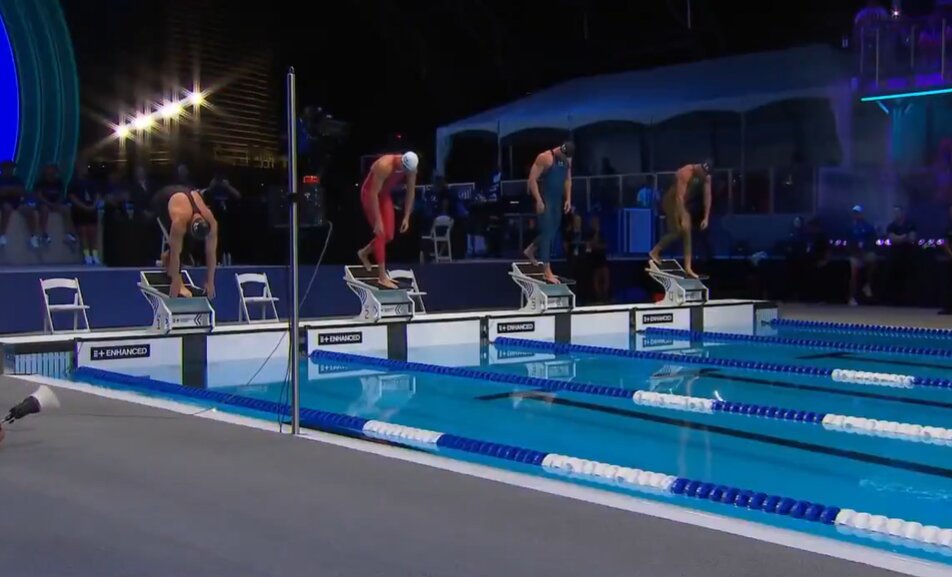
Kristian Gkolomeev touched the wall in 20.81 seconds, and in that instant, the Enhanced Games got exactly what they were built to create: a headline that world sport could not ignore.
The Greek swimmer delivered a stunning performance in the 50m freestyle, beating the previous world record mark of 20.88 seconds and placing himself at the center of one of the most controversial conversations in modern sport. In the pool, it was a moment of pure speed. Outside it, the debate was far more complicated.
The Enhanced Games, often described as the “Olympics on steroids,” have positioned themselves as a radical alternative to traditional elite competition. Their model challenges the rules that have shaped global sport for generations. And now, after Gkolomeev’s 20.81-second swim, the central question becomes unavoidable: what does a record mean if the sport’s major governing bodies refuse to recognize it?
For the organizers, the moment was proof of concept. For traditional federations, it was another reason to draw a hard line.
A Swim Built for Shock Value
The 50m freestyle is one of sport’s most unforgiving events. There is almost no room for correction, no time to recover from a poor start, and no chance to slowly build into rhythm. It is explosive, brutal, and brutally honest. A swimmer gets one length of the pool to prove everything.
Gkolomeev did exactly that.
His 20.81-second time was faster than the previous 20.88 mark, a margin that may look tiny on paper but carries enormous meaning in sprint swimming. At this level, records are not broken by accident. They are usually shaved down by fractions, by perfect starts, clean underwater work, sharp turnover, and the ability to hold power through the final meters.
The number alone is extraordinary.
But the event around it makes the achievement impossible to discuss in normal terms.
This was not a standard world championship race. It did not happen under the familiar framework of traditional Olympic sport. It came at the Enhanced Games, where the very concept of performance is being presented through a different lens. That is why the swim will be celebrated by some as a breakthrough and dismissed by others as incompatible with official competition.
Why Federations Are Refusing Recognition
The major sports federations have made their stance clear: they will not recognize records from the Enhanced Games.
That refusal is not just administrative. It is philosophical.
Traditional sport has built its credibility around rulebooks, anti-doping structures, eligibility systems, and standardized competition environments. Records are not simply numbers. They are accepted because they emerge from a framework that governing bodies consider fair, regulated, and comparable across time.
The Enhanced Games challenge that entire foundation.
By allowing a model that sits outside the accepted boundaries of mainstream sport, the event creates performances that may be faster, stronger, and more dramatic, but not officially comparable in the eyes of the established system.
That is why Gkolomeev’s 20.81 seconds now lives in a strange space.
It is faster than the recognized world record. It will be replayed, debated, and discussed. But unless governing bodies change their position, it will not enter the official record books.
This is where the tension becomes fascinating.
Fans may see the time and call it history. Federations will see the same time and call it unofficial. The athlete may know he swam faster than anyone before him in that setting, while the sport’s official structure may refuse to treat it as a world record.
The Meaning of a Record Is Now Under Pressure
Records are supposed to be simple. A time is faster, a distance is longer, a height is greater. The number wins.
But modern sport has never been that simple.
Context matters. Conditions matter. Rules matter. The authority validating the result matters. That is especially true in swimming, where records are tied tightly to competition standards, timing systems, pool requirements, and regulatory approval.
Gkolomeev’s swim forces a bigger conversation about whether performance alone should define greatness, or whether greatness needs to exist inside an agreed sporting code.
The Enhanced Games will argue that human limits are being pushed. Traditional federations will argue that limits only matter when they are pursued under recognized rules.
Neither side is likely to move quickly.
That means performances like this will continue to create two parallel realities: one driven by spectacle, the other by institutional legitimacy.
Gkolomeev Becomes the Face of a Bigger Debate
For Kristian Gkolomeev, this swim is both a personal landmark and a public storm.
Any swimmer who goes 20.81 in the 50m freestyle has done something remarkable from a pure performance standpoint. It takes extraordinary speed, power, and technical execution to reach that time. The athlete still has to dive, accelerate, hold form, and finish under pressure.
Yet his name will now be attached not only to the clock, but to the controversy surrounding where the swim happened.
That is the complicated reality of competing in an event like the Enhanced Games. The performance gets attention, but it also arrives with questions that traditional athletes usually do not have to answer in the same way. Was it historic? Was it official? Should it be celebrated? Should it be separated from recognized sport entirely?
Gkolomeev’s time ensures those questions will not fade quietly.
A Landmark Moment for the Enhanced Games
For the Enhanced Games, this is exactly the kind of moment that gives the project visibility.
A record-breaking swim, a world-class athlete, and immediate opposition from established federations create the perfect storm of attention. Whether people support or reject the concept, they are now talking about it.
That may be the point.
The event is not trying to blend quietly into the sporting calendar. It is trying to disrupt it. A time like 20.81 seconds in one of swimming’s most iconic sprint events gives the Enhanced Games a powerful marketing weapon. It allows the organizers to claim that their model can produce performances beyond traditional limits.
But attention is not the same as acceptance.
The path from shock value to sporting legitimacy is much harder. Without recognition from major federations, every record will remain unofficial in the eyes of mainstream sport. That creates a ceiling on how these performances are remembered historically, no matter how fast the times become.
What Comes Next
Gkolomeev’s swim may become a turning point, not because it settles the debate, but because it intensifies it.
The 20.81-second time will be used by supporters of the Enhanced Games as evidence that sport can be pushed into a new frontier. It will be used by critics as evidence that performances outside traditional rules should not be compared with official records.
Both reactions will shape the future of this project.
For now, the sporting world is left with a number that cannot be ignored and a record that many authorities refuse to accept.
That contradiction is the story.
Kristian Gkolomeev swam faster than the previous 50m freestyle world record mark. The clock said 20.81. The federations say it will not count.
In the water, it looked like history.
In the record books, the fight has only just begun.

