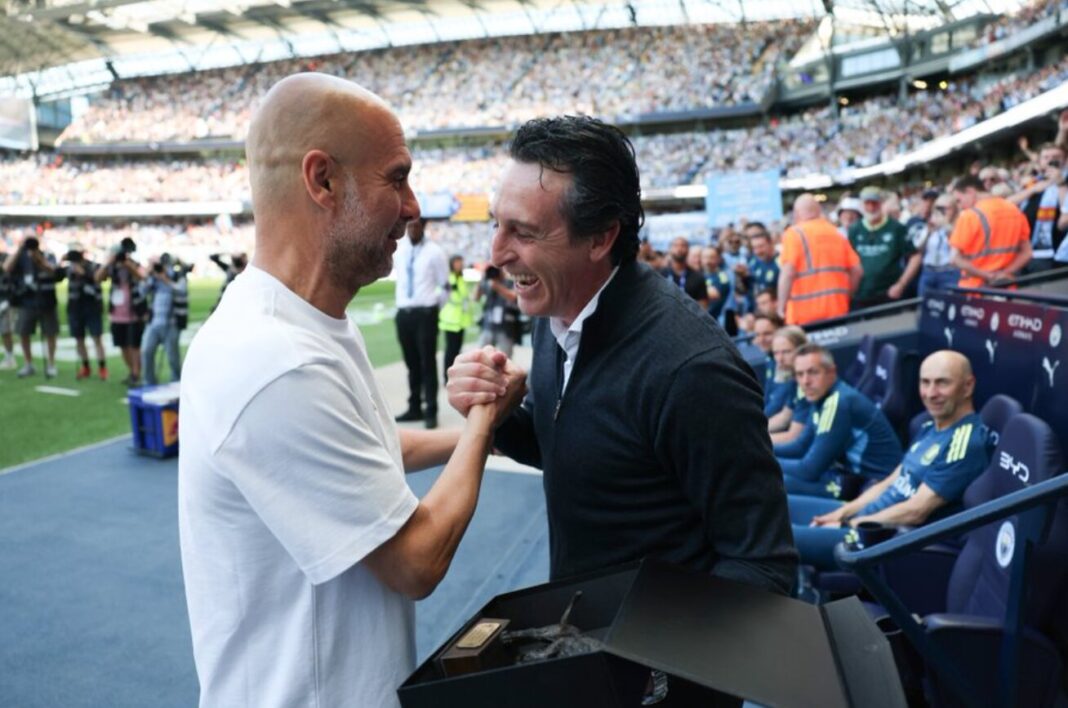
Pep Guardiola’s Manchester City story did not end with the perfect final scene. There was no late winner, no trophy lift, no sweeping farewell victory at the Etihad. Instead, there was defeat, emotion, and a stadium full of people trying to process the end of the most transformative era in the club’s history.
Manchester City lost 2-1 to Aston Villa on Sunday in Guardiola’s final game in charge, as Unai Emery’s side spoiled the farewell with a sharp comeback. Antoine Semenyo gave City the early breakthrough, briefly raising hopes that the day might follow the script supporters had imagined. But Ollie Watkins struck twice in quick succession, turning the occasion into a painful reminder that football rarely offers clean endings, even to its greatest architects.
For Guardiola, though, the result will not define the goodbye.
The numbers are too big. The memories are too deep. The transformation is too complete.
After 593 matches, 416 wins, and 20 major trophies, including six Premier League titles and a Champions League, Guardiola leaves Manchester City not simply as their greatest manager, but as the man who changed what the club believed was possible.
Etihad Turns Into a Farewell Stage
From the moment supporters arrived, this felt different.
The Etihad was dressed for history. Fans wore special-edition kits, held banners, and turned the stands into a tribute to the manager who turned City from a powerful club into a footballing machine. One message captured the feeling perfectly: “Game Changer, History Maker, City Forever.”
It was not just a slogan. It was a summary of a decade.
Guardiola changed City’s football, but he also changed their expectations. Before him, winning was celebrated. Under him, winning became the standard. City did not just chase trophies. They chased control, beauty, domination, and perfection.
That is why the atmosphere carried so much weight.
Supporters were not only saying goodbye to a manager. They were saying goodbye to a way of life. The intensity on the touchline, the constant tactical adjustments, the obsession with positioning, the demand for one more pass, one more press, one more run. It all became part of City’s identity.
On Sunday, those familiar images carried extra emotion.
Every Guardiola gesture felt like a final memory being stored.
Semenyo Starts the Dream, Watkins Breaks the Script
For a few minutes, it looked as though City might give Guardiola the ending everyone wanted.
Antoine Semenyo’s opener brought the Etihad to life. The goal felt like the beginning of a final tribute performance, the type of early strike that allows a stadium to celebrate freely. City had the lead, the emotion, and the crowd behind them.
But Aston Villa had no interest in becoming background characters in Guardiola’s farewell.
Unai Emery’s side responded with discipline and courage, refusing to be overwhelmed by the occasion. Watkins then delivered the decisive spell of the match, scoring a quickfire brace that shifted the mood completely. In a matter of moments, City went from controlling the farewell narrative to chasing the game.
It was classic Villa under Emery: organized, sharp, and ruthless when the chance arrived.
Watkins’ movement created uncertainty in City’s back line, and his finishing carried the coldness needed to silence a stadium built for celebration. The brace did more than win the match. It gave Villa a statement victory on one of the most emotionally charged afternoons of the Premier League season.
For City, there was frustration. But there was also perspective.
This day was bigger than the scoreline.
Bernardo and Stones Receive Emotional Ovations
The farewell was not only about Guardiola.
Departing stars Bernardo Silva and John Stones were also given standing ovations, and both were visibly overcome by the moment. Tears flowed as the Etihad recognized two players who helped define the Guardiola era in their own ways.
Bernardo became one of the symbols of City’s intelligence and sacrifice. Technically brilliant, tactically flexible, tireless without the ball, and endlessly reliable in big matches, he represented so much of what Guardiola valued in a footballer. He could play wide, central, deeper, higher, and still make the team better.
Stones, meanwhile, became one of Guardiola’s great reinvention stories.
From a talented defender under pressure to a hybrid centre-back-midfielder capable of changing the structure of elite matches, Stones’ evolution showed the depth of Guardiola’s coaching imagination. He did not simply improve players. He changed how their positions were understood.
Their emotional reactions told the truth of the day.
This was not a normal end-of-season match. It was the closing of a dressing-room chapter. A group that had climbed English and European football together was beginning to break apart.
Guardiola’s Legacy Goes Beyond Trophies
Twenty major trophies will always sit at the centre of Guardiola’s City legacy.
Six Premier League titles made City the dominant force in English football. The Champions League finally gave the project its European completion. Domestic cups added more proof of depth, hunger, and relentless standards.
But Guardiola’s impact cannot be measured by silverware alone.
He changed the tactical language of the Premier League. Full-backs moved inside. Centre-backs became playmakers. Goalkeepers became the first attackers. Wingers held width with discipline. Midfielders controlled space as much as possession.
Every rival had to respond.
Some copied him. Some built systems specifically to stop him. Some tried to match City’s intensity in recruitment, coaching, and tactical detail. The entire league became sharper because Guardiola forced it to be.
That is the mark of a truly historic manager.
He did not just win within the environment. He altered the environment.
No Fairytale, But No Regret
The 2-1 defeat to Aston Villa denied Guardiola a fairytale ending, but perhaps there was something fitting about the imperfection.
His time at City was built on the pursuit of perfection, yet never without struggle. There were painful Champions League exits. There were brutal title races. There were tactical failures, criticism, exhaustion, and moments when even City’s machine looked human.
That made the triumphs more meaningful.
The final game offered one last reminder that football cannot be fully controlled, even by the man who came closer than anyone to controlling it. Guardiola could design systems, dominate possession, build champions, and rewrite records. But he could not script the ending.
Aston Villa took that away.
History did not.
City Forever
When Guardiola walked away from the touchline, he left behind more than statistics.
He left behind players who became legends, supporters who saw their club touch heights once difficult to imagine, and a football identity that will remain long after his departure. City will appoint another manager. New players will arrive. New eras will begin.
But there will always be a before and after Guardiola.
Before him, Manchester City were ambitious.
Under him, they became a dynasty.
His final game brought tears, banners, standing ovations, and a defeat that hurt in the moment. Yet the larger truth was visible everywhere inside the Etihad. The fans did not come only to watch a match. They came to thank the man who changed their club forever.
No fairytale ending was needed to prove his greatness.
Pep Guardiola leaves Manchester City as a game changer, a history maker, and exactly what the banners said he would always be.
City forever.

