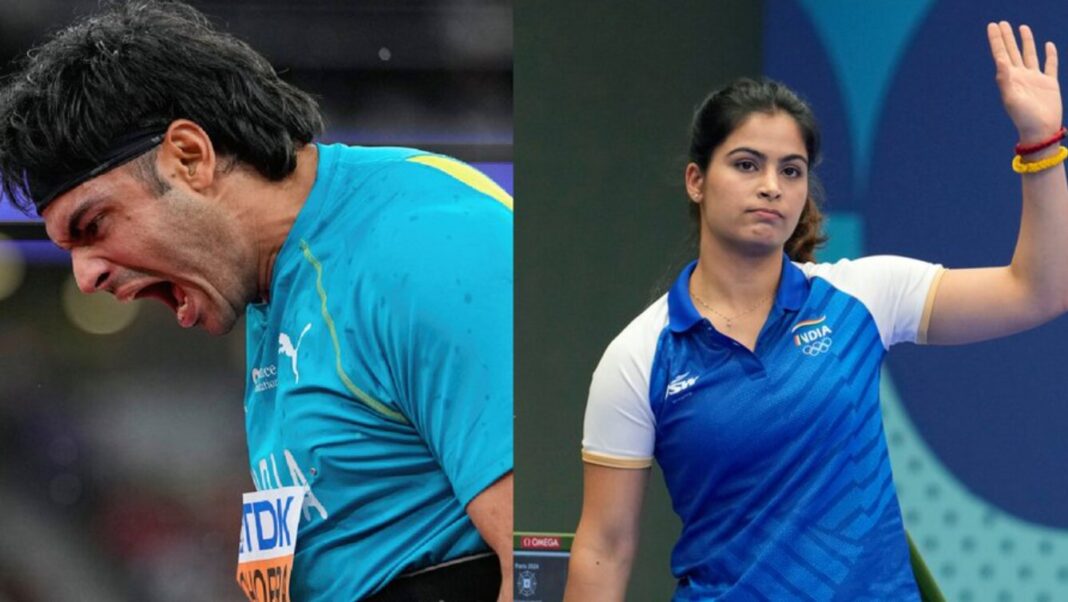
India’s preparations for a packed international sporting calendar gathered momentum on Wednesday after Neeraj Chopra and Manu Bhaker received approval for crucial overseas training programs ahead of the Commonwealth Games and Asian Games season.
While Chopra continues recovering from a back injury that has interrupted parts of his campaign, the Olympic champion is now set to travel to Bienne, Switzerland, on May 25 for an extended 47-day off-season training camp at the renowned Olympic Training Centre.
Bhaker, meanwhile, has already departed for Italy after the Sports Ministry cleared her foreign exposure proposal during the Mission Olympic Cell’s 173rd meeting held on Wednesday.
The decisions underline how seriously India is approaching preparations for two of the biggest multi-sport events on the calendar. For athletes operating at the highest level, overseas camps are no longer viewed as luxury additions to training schedules. They are strategic necessities.
And for Chopra and Bhaker, these next few weeks could play a major role in shaping India’s medal ambitions later this year.
Chopra Prioritising Fitness Recovery Ahead of Heavy Season
For Chopra, the Switzerland camp appears centered around one critical objective: getting his body fully ready for the demands of another major championship year.
Back injuries remain particularly concerning for elite javelin throwers because the event places enormous rotational stress on the spine and core during explosive release phases. Even minor discomfort can significantly affect rhythm, technique, and throwing confidence.
That reality likely influenced the decision to prioritize a long recovery-focused training block in Bienne.
The Swiss facility has become one of the preferred destinations for elite international athletes because of its controlled training environment, advanced recovery systems, and high-performance infrastructure. Chopra has previously benefited from overseas camps in Europe, where training conditions often mirror the demands of major global competitions more closely than domestic setups.
The timing also matters.
With the Commonwealth Games and Asian Games approaching, India’s biggest athletics star cannot afford rushed preparation or recurring fitness setbacks. The goal now appears clear: rebuild physically, regain rhythm gradually, and ensure he enters the second half of the season fresh rather than overloaded.
Despite the injury concerns, Chopra is still expected to compete at both the Commonwealth Games and the Asian Games, where expectations around him remain enormous.
That pressure has followed him ever since his historic Olympic gold transformed Indian athletics.
Manu Bhaker Focused Fully on Asian Games Mission
Bhaker’s pathway looks slightly different.
Since shooting has been omitted from the upcoming Commonwealth Games program, the young Indian star will focus entirely on preparing for the Asian Games, a competition that traditionally features some of the strongest shooting fields in the world.
Her move to Italy reflects the growing trend among elite shooters to seek high-level international exposure before major events. Competing and training in Europe often provides access to advanced ranges, diverse competition styles, and intense match simulation environments that are difficult to replicate consistently elsewhere.
For Bhaker, these overseas experiences have become increasingly important in refining both technical execution and mental composure.
Shooting at the highest level is often decided by fractions. Tiny shifts in rhythm, concentration, or emotional control can determine podium finishes. International camps therefore become as much psychological preparation as technical development.
The Italy training block is expected to help Bhaker sharpen those competitive instincts before the Asian Games campaign begins.
Mission Olympic Cell Continues Aggressive Preparation Strategy
The approvals granted during the Mission Olympic Cell’s 173rd meeting also reveal the Sports Ministry’s broader approach heading into another crucial international cycle.
India’s elite athletes are increasingly being supported through structured foreign exposure plans, specialized recovery programs, and high-performance training opportunities abroad. That represents a significant shift from earlier eras, when many athletes relied heavily on domestic preparation despite competing against globally experienced opponents.
Now, medal prospects are being treated with far more long-term planning.
The willingness to approve Chopra’s 47-day Switzerland camp despite his injury rehabilitation demonstrates how carefully authorities are managing one of India’s most valuable sporting assets.
Similarly, Bhaker’s overseas shooting preparations highlight the importance placed on maintaining India’s strength in disciplines where Olympic and Asian Games medals are realistic expectations.
Expectations Around Chopra Continue Growing
Even while injured, Chopra remains one of the most closely watched athletes in Indian sport.
Every update around his fitness immediately becomes national conversation because of what he represents beyond athletics itself. His Olympic success changed perceptions around track-and-field sports in India and inspired a generation of young athletes to believe global success was genuinely possible.
That visibility brings pressure.
Whenever Chopra competes now, expectations are not limited to participation or podium finishes. Fans expect dominance. Gold medals have become the benchmark.
Managing those expectations while recovering physically will be one of the biggest challenges heading into the coming months.
The Switzerland camp could therefore become just as important mentally as physically, offering him a controlled environment away from constant public attention before the competitive season intensifies again.
India Building Toward Crucial Multi-Sport Year
For Indian sport overall, the movements of Chopra and Bhaker symbolize something larger.
The country is entering another major multi-sport cycle with rising ambitions and growing confidence across disciplines. Athletes are no longer traveling internationally merely to participate. Increasingly, they are preparing to challenge the world’s best consistently.
That shift is visible in the planning.
Specialized camps. Recovery management. International exposure. Long-term performance strategy.
All of it points toward a system trying to maximize medal potential at the highest level.
Now the focus turns toward execution.
For Neeraj Chopra, the next step is recovery, rhythm, and readiness in Switzerland.
For Manu Bhaker, it is precision and preparation in Italy.
And for India, the countdown toward another high-pressure international sporting season has officially begun.

