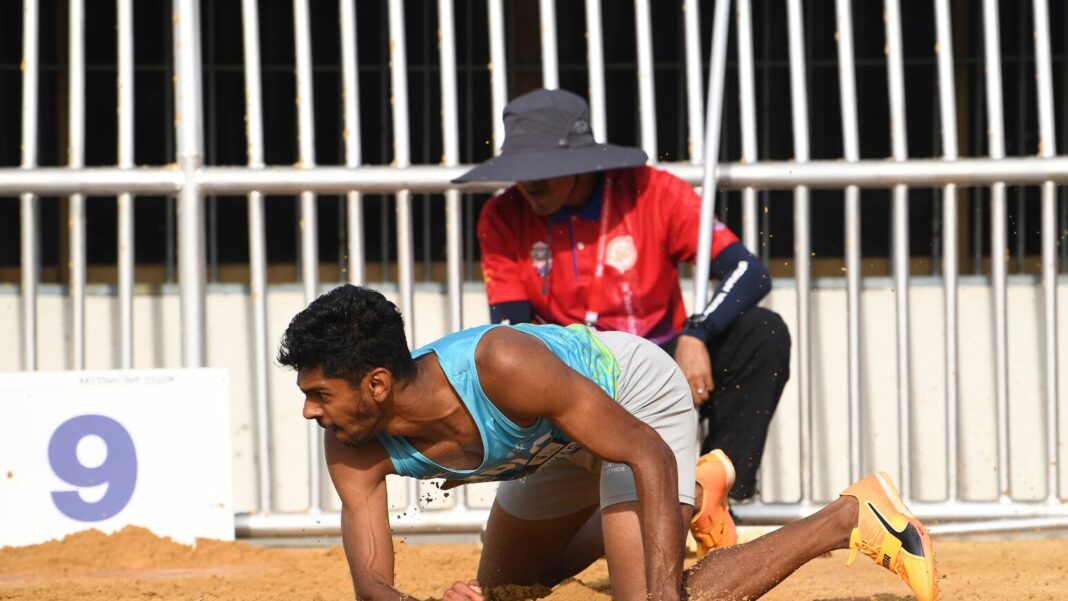
Pretoria, South Africa: Murali Sreeshankar continued his impressive early-season form by clinching the men’s long jump title at the Simbine Classic 2026 athletics meet, delivering a confident performance that reinforces his growing stature on the global stage.
Competing at Pilditch Stadium, the 27-year-old Indian athlete registered a winning jump of 8.12 metres, finishing ahead of South Africa’s Divan Manuel (8.07m) and experienced campaigner Luvo Manyonga, the Rio 2016 Olympic silver medallist, who managed 7.86m.
A Statement Performance Early in the Season
Sreeshankar’s victory is not just about the distance but the timing and consistency behind it. Crossing the 8-metre mark early in the season is often seen as a strong indicator of an athlete’s readiness for bigger international competitions later in the year.
For Sreeshankar, this performance builds on the momentum he has been steadily developing over the past few seasons. After securing a silver medal at the Asian Games, expectations have been rising around his ability to consistently challenge top-tier global competitors.
The 8.12m jump, while not his personal best, reflects control, rhythm, and technical execution—key elements in long jump success. More importantly, it shows he is competing at a high level without peaking too early, a crucial factor in athletics planning.
Why This Win Matters
In modern athletics, especially in field events like long jump, consistency often separates elite athletes from occasional performers. Sreeshankar’s ability to deliver multiple strong jumps across competitions indicates that his training and conditioning are aligned with long-term goals rather than short bursts of form.
Winning in South Africa also adds value because of the competitive field and conditions. Facing local athletes like Manuel and Manyonga, who are familiar with the surface and environment, gives additional weight to Sreeshankar’s achievement.
Moreover, competing internationally early in the season helps athletes adapt to travel, different weather conditions, and varied track surfaces—factors that can significantly influence performance during major championships.
Technical Growth and Maturity
One of the most notable aspects of Sreeshankar’s recent performances is his improved consistency on the runway and take-off board. In long jump, even minor technical errors can result in fouls or reduced distances. His ability to maintain clean jumps while still achieving competitive distances suggests a higher level of maturity in his approach.
This technical stability is often the result of focused training cycles, biomechanical refinement, and experience gained through international exposure. Over the past few years, Sreeshankar has been working on improving his speed, take-off angle, and landing efficiency—all of which appear to be coming together.
Competition Context: A Balanced Field
The presence of Luvo Manyonga, a proven performer on the Olympic stage, adds credibility to the event. While Manyonga’s jump of 7.86m may not reflect his peak form, competing against such experienced athletes provides valuable benchmarking for emerging contenders like Sreeshankar.
Divan Manuel’s 8.07m effort also highlights the competitiveness of the field. The narrow margin between first and second place emphasizes that Sreeshankar had to deliver under pressure rather than relying on a one-off big jump.
What This Means for India
Sreeshankar’s rise is significant for Indian athletics, particularly in field events where global podium finishes have historically been limited. His consistent performances are helping shift perceptions, showing that Indian athletes can compete and win against strong international fields outside the subcontinent.
With major global events on the horizon, including World Championships and Olympic qualification cycles, performances like this play a crucial role in building confidence and ranking points.
Looking Ahead
While this victory is a positive step, the focus will now shift to maintaining form and gradually improving distances as the season progresses. The key for Sreeshankar will be balancing competition exposure with training, ensuring he peaks at the right time.
If he continues on this trajectory, crossing the 8.20m or even 8.30m mark consistently could place him firmly among the world’s elite long jumpers.
For now, the Simbine Classic win serves as a strong statement: Murali Sreeshankar is not just participating on the global stage—he is competing to win.
Source: Olympic.com

