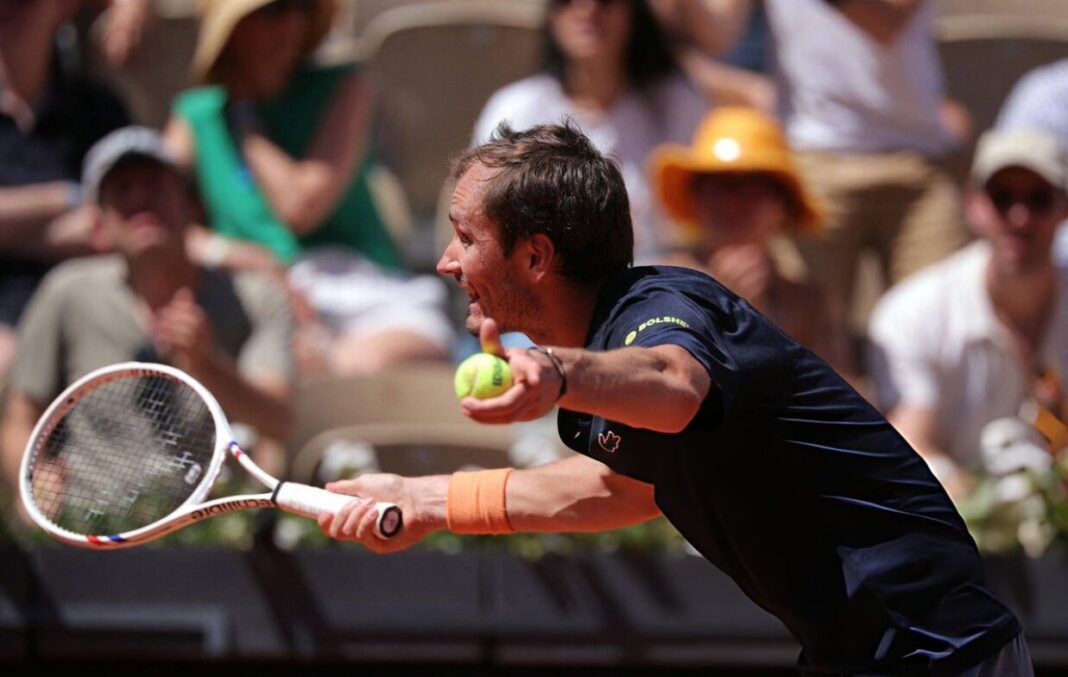
For Daniil Medvedev, Roland Garros has again become the scene of a familiar kind of pain.
The former world No. 1 watched history repeat itself in brutal fashion on Tuesday, falling in the first round after another five-set battle that carried an uncomfortable echo from the previous year. This time, it was Australia’s Adam Walton who delivered the blow, completing a victory that will feel enormous for him and deeply frustrating for Medvedev.
The cruelest part was not only the defeat. It was the way it unfolded.
Twelve months ago, Medvedev lost to Cameron Norrie in a five-set opener after letting a break advantage slip away in the deciding set. One year later, the same pattern returned. Another first-round match. Another fifth set. Another lead that disappeared. Another early exit from Paris.
For a player of Medvedev’s stature, that kind of repetition hurts more than a routine loss. It raises questions not only about form, but about confidence in the most fragile moments of a Grand Slam match.
A Familiar Collapse at the Worst Possible Time
Five-set tennis has a way of stripping a player down emotionally.
Tactics matter, fitness matters, shot tolerance matters, but the deciding set often becomes about nerve. Every service game feels heavier. Every missed first serve feels louder. Every half-chance carries the pressure of the entire match.
Medvedev knows that better than most. His career has been built on problem-solving, patience, and the ability to drag opponents into uncomfortable patterns. But at Roland Garros, those strengths have not always translated into safety.
Against Walton, the match again reached the point where Medvedev had an opening. A fifth-set lead should have been the platform for survival. Instead, it became the beginning of another painful unraveling.
That is what will bother him most.
Losing in five sets is never easy, but losing after gaining control in the final set leaves a different scar. It is not just about being beaten. It is about knowing the escape route was there and still slipping away from it.
Walton Seizes His Moment
For Adam Walton, this was the kind of match that can change a career’s temperature.
Facing a former No. 1 at a Grand Slam is a test of belief before it is a test of tennis. The name across the net carries weight. The ranking history carries weight. The moment carries weight. Many players get close in matches like this but lose their nerve when the favorite begins to reassert control.
Walton did not.
That is the defining part of his win. When Medvedev moved ahead in the fifth set, the match could easily have drifted away from the Australian. Instead, he stayed present. He kept competing through the scoreboard pressure and forced Medvedev to keep proving he could close the door.
In Grand Slam tennis, that persistence is often enough to turn doubt into momentum.
Walton’s victory was not only about taking advantage of Medvedev’s discomfort. It was about refusing to let the occasion become too big. Once the fifth set tightened, he had to trust his legs, his timing, and his willingness to keep asking questions.
Medvedev failed to answer enough of them.
Why Roland Garros Keeps Testing Medvedev
Medvedev’s relationship with Roland Garros has always felt complicated.
His game is built around flat hitting, court coverage, awkward rhythm, and defensive intelligence. On many surfaces, those qualities make him one of the most difficult players in the world to solve. He can absorb pace, redirect angles, and turn rallies into mental battles.
But clay changes the conversation.
The surface asks for patience in a different way. It rewards shape, spin, sliding balance, and the ability to build points with repeated pressure. Medvedev can compete on it, but the margin often feels thinner. Opponents get extra time. Defensive positions become more demanding. Closing out matches can become a longer, heavier task.
That may be why these defeats feel so damaging.
At other tournaments, Medvedev’s style can suffocate opponents late in matches. In Paris, he has sometimes looked less able to impose that final layer of control. When the match becomes physical and tense, the surface gives opponents enough life to keep coming back.
Norrie did it last year.
Walton has done it now.
The Mental Weight of Repetition
The phrase “deja vu” matters here because players are not machines. They remember.
When a similar situation returns after a painful defeat, the body and mind react. A fifth-set lead at Roland Garros may look like a chance for redemption from the outside. For the player living it, it can also bring back the memory of what went wrong before.
That is the mental trap.
Medvedev would have known the match was within reach. He would also have felt the pressure of making sure last year’s collapse did not repeat itself. The harder a player tries to shut out that thought, the louder it can become.
This is where Grand Slam tennis becomes ruthless.
There is nowhere to hide in a deciding set. A player cannot wait for teammates to cover him. He cannot call time and reset the whole structure. He has to solve the match alone, point by point, while the opponent grows more confident with every missed chance.
Medvedev has built a career on handling difficult moments, but this was another reminder that even elite players carry scars.
A Result That Raises Questions
For Medvedev, the immediate consequence is clear: another early Roland Garros exit and another major disappointment on the Paris clay.
But the larger questions will follow.
How does he stop this pattern from becoming part of the story? How does he rebuild confidence in deciding sets at Roland Garros? How does he regain control of matches when the surface and the opponent refuse to let him finish quickly?
These are not simple tactical issues. They are emotional and strategic problems combined.
Medvedev remains too accomplished, too intelligent, and too competitive to be judged by one match alone. But when the same type of defeat happens in back-to-back years, it becomes harder to dismiss as coincidence.
The margins at Grand Slam level are brutal. A break lead in a fifth set can be the difference between survival and crisis. Medvedev has now twice stood close to survival in Paris and watched the match turn away from him.
Walton’s Win, Medvedev’s Warning
For Walton, this victory will be remembered as a breakthrough moment. Beating a former No. 1 in a five-set Grand Slam match demands courage, discipline, and belief. It gives him a story, momentum, and proof that he can live in the pressure of a major stage.
For Medvedev, it is a warning.
Not because his quality has disappeared, but because the pattern has become too familiar. Roland Garros has found a way to expose him again, not through a quick defeat, but through the slow cruelty of a match he had chances to win.
That is what makes this loss sting.
He was not blown away. He was not outclassed from start to finish. He was there, deep in the fifth set, with control close enough to touch.
Then it slipped.
A year after Cameron Norrie punished him in similar fashion, Adam Walton delivered the sequel. Same stage, same round, same five-set heartbreak, same final-set regret.
For Medvedev, Roland Garros has once again turned into a mirror he did not want to look into.

