For Arsenal, this was more than a win. It was a release.
Years of frustration, near misses, rebuilding, criticism, patience, and belief all came pouring out as Mikel Arteta’s side sealed a historic Premier League title with a 2-1 victory over Crystal Palace. At the final whistle, the scoreline almost felt too small to contain the meaning of the day. Arsenal had not just beaten Palace. They had finally crossed the line.
The long wait since the Invincibles era is over.
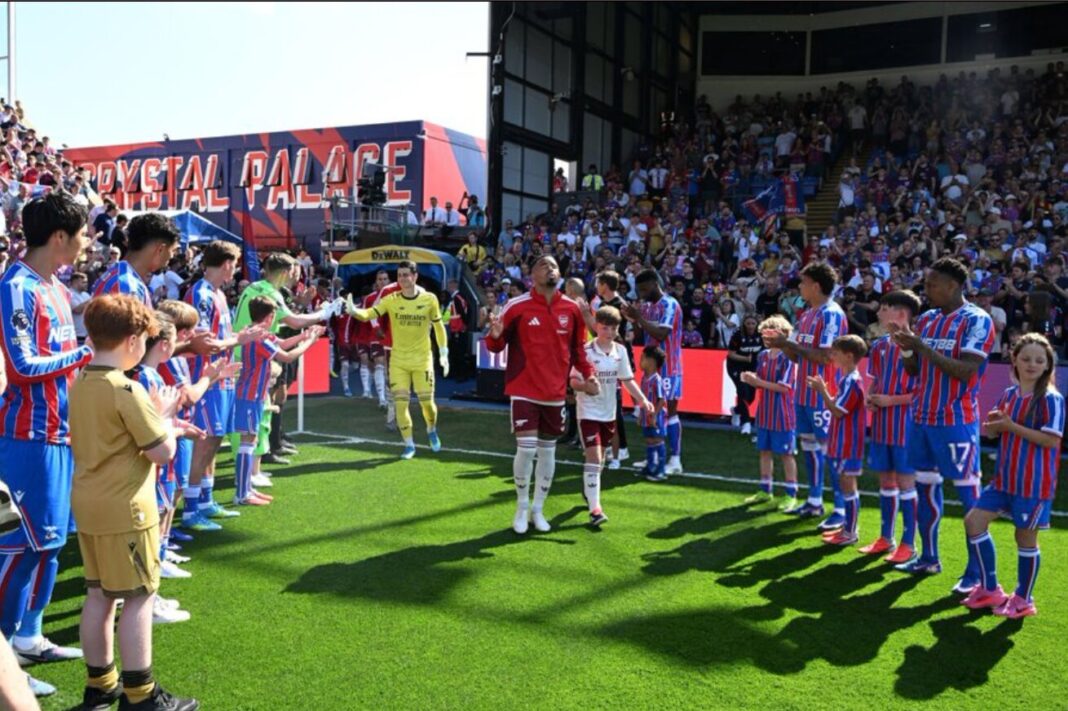
Before kickoff, Crystal Palace formed a guard of honour, a gesture that confirmed what the table had already made clear. Arsenal were champions. Yet Arteta’s players still had one more job to do in front of a fanbase desperate to celebrate the title with a performance that carried the tone of the season: controlled, brave, and full of belief.
They delivered.
Goals from Gabriel Jesus and Noni Madueke secured the victory, while Jean-Philippe Mateta’s late reply gave Palace a flicker of pride without changing the larger story. This was Arsenal’s day, Arsenal’s season, and perhaps the clearest proof yet that Arteta’s long rebuild has finally reached its defining moment.
A Guard of Honour, Then a Champion’s Response
The guard of honour gave the afternoon its emotional opening.
For Arsenal players, walking through that line of Palace shirts must have carried a strange mix of pride and pressure. It was recognition, but also a reminder. Champions are not only celebrated. They are watched more closely. Every touch, every duel, every reaction becomes part of the image of a title-winning side.
Arsenal did not shrink from it.
There was a calmness in their early play, the kind that has become central to their title charge. This was not a team chasing validation anymore. This was a team that knew what it had become. Arsenal controlled the rhythm, moved the ball with purpose, and waited for the moments when Palace’s defensive shape began to stretch.
Gabriel Jesus gave them the breakthrough, adding the kind of sharp attacking contribution that title-winning teams need from experienced forwards. His goal was not just a finish. It was a reminder of the value he has brought to this squad: movement, intelligence, work rate, and big-game courage.
Jesus has not always had a smooth road at Arsenal, but his influence in matches like this goes beyond numbers. He presses with hunger, drags defenders out of position, and gives the attack a restless edge. On a day full of emotion, his goal settled nerves and allowed the champions to play with greater authority.
Madueke Adds the Decisive Touch
Noni Madueke’s goal gave Arsenal the cushion they needed and added another layer to the story of a squad built with both ambition and depth.
Title-winning teams are rarely carried by one star alone. They need different players stepping forward at different times. They need wide players who can stretch games, forwards who can finish half-chances, midfielders who can control tempo, and defenders who can survive uncomfortable spells.
Madueke’s contribution felt exactly like that: a piece of the wider machine clicking at the right moment.
His ability to attack space and bring directness gave Arsenal another route through Palace. In a game where emotion could easily have taken over, Madueke’s finish helped turn celebration into control. It made the result feel secure, even before Palace’s late response briefly tightened the final minutes.
Mateta’s goal offered Palace something to take from the afternoon. It showed their refusal to simply play the role of guests at Arsenal’s party. But even that late strike could not break the feeling that this match belonged to the visitors and their history-making campaign.
Max Dowman Writes His Own Piece of History
Amid the title celebrations, 16-year-old Max Dowman produced one of the most remarkable stories of the day.
By starting the match, he became the youngest starter and title winner ever, adding a stunning personal milestone to Arsenal’s collective triumph. In a club that has always taken pride in youth, development, and technical promise, Dowman’s involvement felt deeply symbolic.
This was not only about a teenager being handed minutes. It was about the direction of the club.
Arteta’s Arsenal have been built around a belief that youth can carry responsibility if surrounded by the right structure. Dowman’s historic appearance underlined that philosophy. He stepped into a title-winning side not as a publicity gesture, but as part of a squad culture where the future is constantly being folded into the present.
For supporters, that matters.
Winning the league is one thing. Winning it while still looking young, hungry, and capable of growing again is something far more frightening for rivals.
Arteta’s Rebuild Finally Delivers
Mikel Arteta’s journey to this moment has been anything but simple.
There were periods when patience ran thin. There were doubts about his methods, his recruitment, his authority, and whether Arsenal could truly return to the highest level under his leadership. Rebuilds are easy to talk about and painful to live through. They demand unpopular decisions, emotional discipline, and belief when results do not arrive quickly enough.
Arteta stayed with the plan.
This title, delivered with more than 90 points, is the reward for that conviction. Arsenal did not stumble into it. They built it through structure, intensity, and a style of play that combined technical quality with emotional resilience.
The Gunners became sharper without the ball, more mature in possession, and harder to bully in decisive moments. The old accusation, that Arsenal could be beautiful but fragile, no longer fits this team. They have added steel to their elegance.
That is what made this title run so powerful.
It was not only about ending a drought. It was about changing the identity of the club again.
A Global Arsenal Celebration
The celebrations did not stop in London.
Arsenal’s title was felt across continents, from Nairobi streets to Uganda gatherings, where supporters erupted in joy as the club finally returned to the top of English football. That global reaction tells its own story about Arsenal’s reach.
This is a club with emotional roots far beyond north London.
For many fans, especially those who grew up hearing stories of the Invincibles, this title represents a connection between generations. Some supporters waited through years of disappointment, watching rivals dominate while Arsenal promised progress but fell short. Others are experiencing this feeling for the first time.
That is the beauty of a title after a long wait.
It belongs to everyone who stayed.
Why This Title Matters
Arsenal’s triumph matters because it closes one era of longing and opens another of expectation.
Since the Invincibles, the club has carried history like both a badge and a burden. Every promising team was compared to that unbeaten side. Every collapse was framed against the standards of the past. Every title challenge carried the question: can Arsenal really do it again?
Now they have.
This 2-1 win over Crystal Palace will not be remembered only for the goals or the late Palace reply. It will be remembered as the day Arsenal finally stepped out of the shadow of what came before. Jesus and Madueke supplied the finishing touches. Dowman made history. Arteta stood as the architect of a rebuild that survived doubt and delivered glory.
The long drought is over.
Arsenal are champions again, and this time the triumph feels like more than the end of a wait. It feels like the beginning of something built to last.

