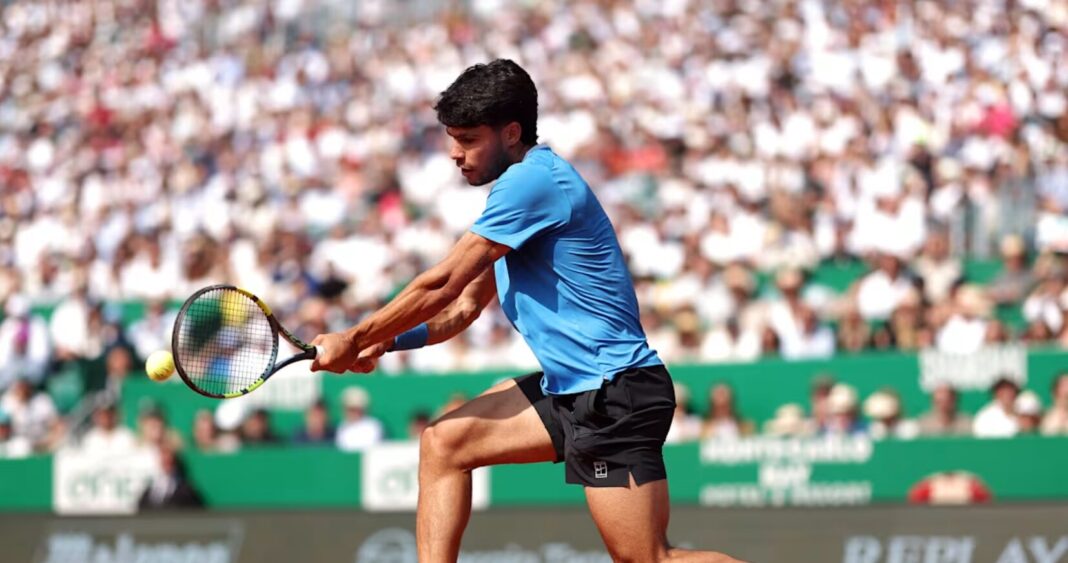
Carlos Alcaraz and Jannik Sinner once again produced a gripping contest defined by momentum swings, missed chances, and razor-thin margins, reinforcing why their rivalry has become one of the most compelling in modern tennis.
The latest clash between Spain’s Carlos Alcaraz and Italy’s Jannik Sinner followed a familiar pattern: explosive starts, immediate replies, and sustained pressure that never allowed either player to fully escape.
Alcaraz began the match with intent, breaking Sinner’s serve in the second game to seize early control. However, the Italian responded almost instantly, breaking back to restore parity and underline why he has become one of the most resilient competitors on the ATP Tour.
From that point onward, Sinner appeared to gain the upper hand in the opening set. He consistently applied pressure on Alcaraz’s service games, creating four break point opportunities while not conceding a single one on his own serve during that stretch. Despite this statistical advantage, the Spaniard’s defensive resilience proved crucial, as he saved every break point he faced to stay alive in the set.
The tension escalated as both players held firm under pressure, eventually pushing the opener into a tiebreak. Even there, the momentum refused to settle cleanly. Sinner carved out two set points, coming within touching distance of taking the lead. One opportunity went missing on his own serve, and the decisive moment arrived when Alcaraz, under pressure, double-faulted—handing the set to his Italian rival in dramatic fashion.
The contest reflected not just a battle of skill, but also contrasting narratives entering the match. On paper, Alcaraz carried the stronger pedigree on clay courts. The Spaniard has already established himself as one of the most dominant players on the surface, with multiple major titles including two French Open crowns, alongside victories at prestigious tournaments such as Madrid, Rome, and Monte Carlo.
Sinner, by contrast, has historically struggled to translate his hard-court dominance onto clay at the same level. While he has rapidly evolved into a world-class all-surface competitor, the red dirt has remained the one surface where his trophy cabinet still lacks a signature breakthrough at the highest level.
Yet form coming into this match suggested a far more dangerous version of the Italian. Sinner has been in extraordinary rhythm, entering the contest with a 21-match winning streak in Masters 1000 events and a 16-match unbeaten run across all competitions. Even more impressively, he had dropped only a single set during that entire stretch, highlighting a level of consistency that few players in the world can match.
Despite this, pre-match expectations still leaned slightly toward Alcaraz, largely due to their historical head-to-head record on clay. The Spaniard has consistently found ways to outmaneuver Sinner on the surface, winning four of their previous clay-court encounters. His ability to combine defensive elasticity with sudden attacking bursts has often been the deciding factor in their matchups.
However, their rivalry has also produced moments that defy trends. The most famous example came at last year’s French Open final, where Sinner came agonizingly close to victory, holding multiple championship points before Alcaraz mounted a dramatic escape to claim the title. That match alone cemented the psychological unpredictability that defines their rivalry.
What makes encounters between Alcaraz and Sinner particularly compelling is not just their technical brilliance, but how evenly they match each other in different phases of the game. Alcaraz typically brings flair, improvisation, and explosive shot-making, while Sinner counters with precision, timing, and relentless baseline pressure. When both players are in form, as they were in this latest meeting, even small moments—like a single double fault or a missed break point—become decisive.
As the match unfolded beyond the opening set, it once again became clear why predicting outcomes between these two remains nearly impossible. Each brings a level of intensity that forces the other to elevate their game, often producing contests that swing on a handful of points rather than clear dominance.
For now, Sinner’s ability to seize the opening set reinforces his current momentum, but history suggests that Alcaraz is never far from a response. In a rivalry already filled with classics, this latest chapter only adds further weight to the growing narrative: whenever Alcaraz and Sinner meet, tennis fans are guaranteed drama, quality, and uncertainty until the very last point.

