A familiar voice of authority is once again shaping the conversation around elite European football. José Mourinho has reportedly delivered a blunt assessment of the current structure at Real Madrid, identifying the club’s defensive system as its biggest weakness and outlining a clear priority for improvement.
According to the latest indications, Mourinho believes that despite Real Madrid’s attacking brilliance and squad depth in advanced areas, the team lacks the defensive reliability required to sustain a full season across domestic and European competitions. His message is not subtle: elite football is ultimately decided by structure, and structure begins at the back.
Defensive Stability Becomes the Central Focus
Mourinho’s core argument is built around one principle he has long championed throughout his managerial career. While attacking talent can win matches, defensive consistency wins titles. For a club operating under constant expectation, even small structural weaknesses can become decisive in high-pressure moments.
In his assessment, Madrid’s primary concern is not individual defending alone, but the balance and depth of options across the back line. Injuries, rotation demands, and tactical shifts across a long season require a defensive unit capable of adapting without losing stability.
This is where Mourinho’s proposed direction becomes more detailed. Rather than relying on a fixed defensive setup, he wants a system built around adaptability, where roles and personnel can change depending on opposition and match context.
Gvardiol and Calafiori Viewed as Ideal Profiles
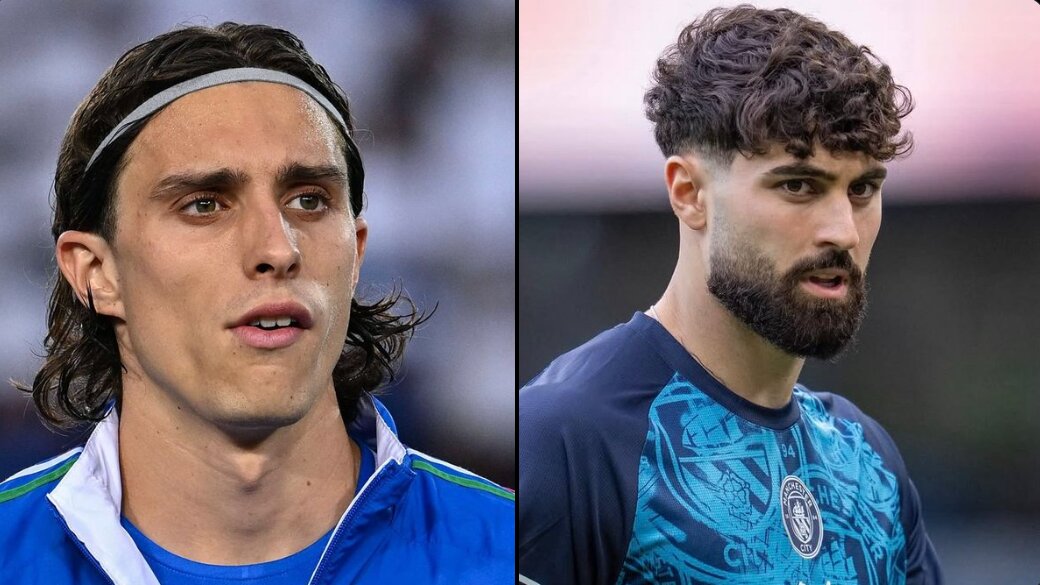
Two names stand out prominently in his reported thinking: Joško Gvardiol and Riccardo Calafiori.
Both players represent modern defensive profiles that align closely with Mourinho’s evolving tactical requirements.
Gvardiol brings physical dominance, composure under pressure, and the ability to operate both as a centre-back and a left-sided defender. His versatility allows teams to shift between back three and back four systems without losing defensive control.
Calafiori, meanwhile, offers a different but equally valuable dimension. Comfortable advancing into midfield zones and contributing to build-up play, he represents the type of progressive defender who can help initiate attacks while still maintaining defensive responsibility.
The combination, in Mourinho’s view, would give Real Madrid something crucial: balance.
A Tactical Blueprint Built on Full-Back Complementarity
Beyond individual targets, Mourinho’s broader concept focuses on how full-backs are used within the system. His idea revolves around pairing contrasting profiles on each side of the pitch.
One full-back would provide attacking width, overlapping runs, and offensive support in the final third. The other would prioritize defensive discipline, positional security, and balance during transitions.
This dual-profile approach is designed to give the team tactical flexibility within a single match. Depending on game state, opposition pressure, or injury situations, Madrid could shift between more aggressive or more conservative structures without making substitutions.
It is a system built not just for style, but for survival across a demanding calendar.
Flexibility as a Weapon in Modern Football
Modern elite football increasingly rewards tactical adaptability. Teams competing deep into the Champions League and domestic title races must adjust constantly to different styles of opposition.
Mourinho’s proposal reflects that reality.
Instead of committing to a single rigid formation, the idea is to create a defensive ecosystem capable of evolving in real time. A match against a low block might demand more attacking full-backs and high defensive lines, while a European knockout tie could require compact structure and conservative positioning.
By building a squad with interchangeable defensive roles, Real Madrid would theoretically gain a competitive advantage in managing different tactical scenarios.
Addressing Long-Season Demands
One of the most overlooked challenges in elite football is squad endurance over a full campaign.
Injuries, fatigue, fixture congestion, and tactical adjustments often expose depth issues in defensive units more than in attacking departments. Mourinho’s emphasis on “sufficient options” reflects his awareness that title-winning teams are rarely defined by their starting XI alone, but by the strength of their rotation players.
For a club like Real Madrid, competing simultaneously in La Liga and the UEFA Champions League, the ability to rotate without structural decline is essential.
That is why defensive reinforcement is being treated as a priority rather than an optional upgrade.
What This Means for Real Madrid’s Evolution
If Mourinho’s assessment influences internal decision-making, it could signal a broader shift in how Real Madrid approach squad construction.
Rather than focusing purely on attacking depth or marquee signings, the emphasis would move toward balance, structure, and defensive reliability. Historically, Madrid have succeeded when their attacking brilliance is supported by strong defensive foundations.
The proposed direction appears to reinforce that philosophy.
Gvardiol and Calafiori represent more than just potential signings. They represent a strategic shift toward defenders who are not limited to traditional roles but are capable of shaping build-up play, transitions, and tactical flexibility.
The Bigger Picture
Whether or not Real Madrid act directly on Mourinho’s specific recommendations, the underlying message is clear. In modern elite football, defensive structure is no longer secondary to attacking quality. It is the foundation that allows attacking talent to flourish consistently.
For Mourinho, whose managerial identity has long been associated with organisation and control, the diagnosis is unsurprising. But the timing is significant, arriving as Real Madrid continue to evolve their squad for the next cycle of dominance.
If changes are made, they will not simply be about strengthening the defense. They will be about redefining how the entire team functions from the back line forward.
And in that sense, Mourinho’s warning is less about criticism and more about direction: Real Madrid’s next era of success, he believes, begins with fixing what happens before the first goal is scored.

