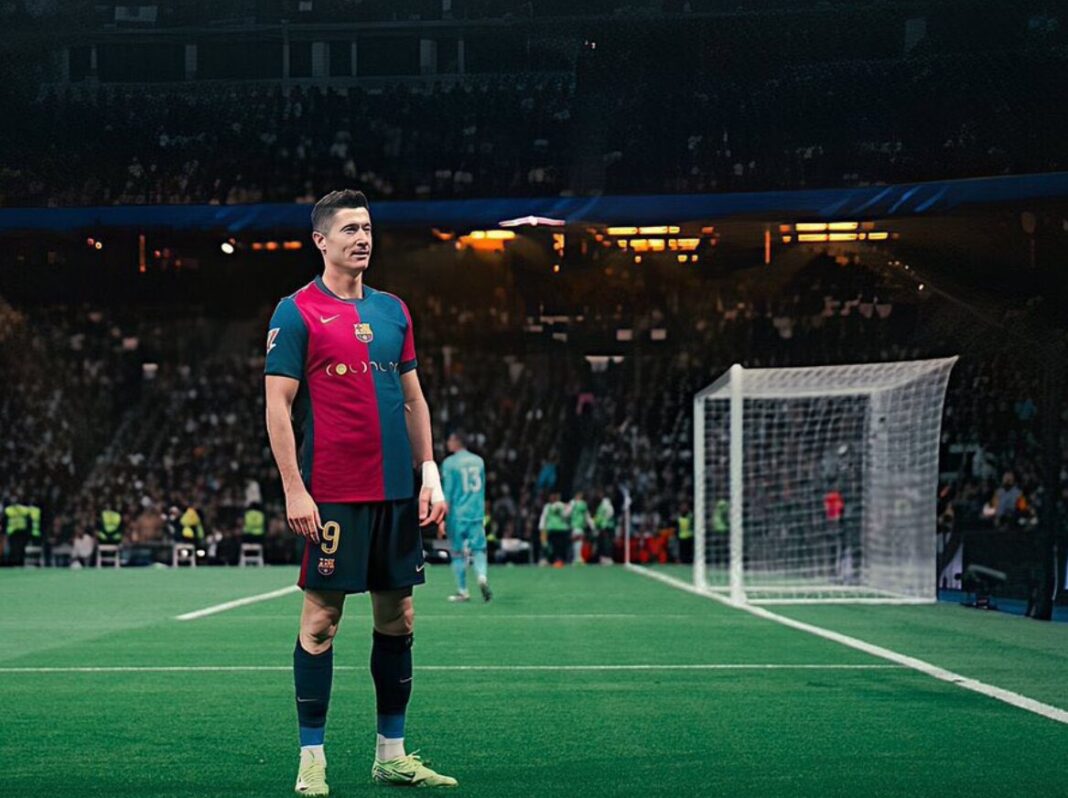
For years, the roar inside Camp Nou often arrived in the same sequence. A quick movement between defenders, a sharp first touch, and then the inevitable finish. Calm, clinical, ruthless. Robert Lewandowski built a career on making the extraordinary look routine, and now one of European football’s most decorated forwards is preparing to close another remarkable chapter.
FC Barcelona confirmed that the 37-year-old striker will leave the club as a free agent following the conclusion of the 2025/26 season, bringing an end to a spell that restored firepower, leadership, and belief to a side searching for identity after years of transition.
The Catalan giants delivered the announcement with a message that instantly resonated with supporters across the football world: “Came as a star. Leaves as legend.”
Few could argue otherwise.
When Lewandowski arrived in Barcelona, questions surrounded the move. Some wondered whether the club, battling financial instability and rebuilding under immense pressure, was signing a fading superstar. Others questioned whether a striker approaching his mid-thirties could still dominate at the highest level in Spain.
Instead, what followed was one of the most impactful late-career transfers modern football has seen.
Across 190 appearances, the Polish international produced 119 goals and 24 assists, numbers that only tell part of the story. Beyond the statistics was the sense of certainty he brought to Barcelona’s attack. In moments when games tightened, when possession alone was not enough, Lewandowski delivered precision and authority inside the penalty area that younger squads often lack.
The trophies followed quickly.
Three La Liga titles, one Copa del Rey, and three Spanish Supercups transformed his Barcelona stint from a high-profile signing into a defining era. More importantly, he became the attacking reference point around which the club rebuilt its competitive edge domestically.
Under coach Hansi Flick, the connection only deepened further. The pair had already enjoyed enormous success earlier in their careers, and their reunion in Spain once again produced silverware and stability. Flick’s tribute carried the tone of someone speaking not only about an elite footballer, but about a trusted leader inside the dressing room.
“We won nine titles together,” Flick said while praising Lewandowski’s professionalism and mentality.
That professionalism became central to Barcelona’s evolving culture. Younger forwards entering the squad often spoke about training standards changing around the veteran striker. Sessions reportedly became sharper, more demanding, more detail-oriented. Lewandowski’s obsession with movement, recovery, and finishing turned him into more than a goal scorer. He became an example.
His impact also arrived during a delicate moment in Barcelona’s history.
The club had spent years navigating uncertainty after the departure of legendary figures and mounting financial complications. Expectations remained enormous, but the aura surrounding the side had weakened. Lewandowski helped restore a sense of elite identity. Even when Barcelona struggled collectively, opponents respected the danger he carried every time the ball entered the final third.
Some of his most memorable moments came in the biggest matches. Crucial league winners, composed finishes in title races, and dominant performances against direct rivals reminded supporters what a world-class No. 9 could still offer in modern football.
Yet perhaps the most impressive part of his Barcelona story was adaptation.
This was not the explosive Borussia Dortmund version of Lewandowski constantly attacking space behind defenses. Nor was it entirely the relentless Bayern Munich machine who overwhelmed Bundesliga backlines week after week. In Spain, he evolved again. Smarter positioning replaced pure physical intensity. His link-up play improved. He dropped deeper when needed, created space for wide players, and still remained devastating near goal.
That football intelligence allowed him to extend his dominance well beyond the age when most strikers begin declining.
Barcelona supporters recognized that evolution quickly. While goals made headlines, the emotional connection grew because of his commitment to the shirt during difficult moments. He arrived when the club needed reassurance and leaves having helped deliver another successful era.
Lewandowski’s farewell message reflected that emotional bond.
The striker thanked supporters and club president Joan Laporta for what he described as a special chapter in Catalonia. Those words carried weight because his move to Barcelona was never viewed as a short commercial stop. It became a genuine football project that reshaped both player and club.
Now attention naturally turns toward what comes next.
At 37, questions about retirement will intensify, though few would confidently bet against him continuing elsewhere. Throughout his career, Lewandowski has repeatedly challenged conventional timelines surrounding elite forwards. His fitness standards remain exceptional, and his technical quality ensures he could still influence games in multiple leagues around the world.
For Barcelona, replacing him will not simply be about finding another scorer.
Replacing 119 goals is difficult enough. Replacing leadership, discipline, experience, and composure inside pressure moments may prove even harder. Modern football increasingly favors fluid attacking systems without traditional strikers, but Lewandowski reminded everyone why elite center-forwards still matter. His presence altered defensive structures before matches even began.
There is also symbolism attached to his departure.
Barcelona’s recent revival was built around experienced figures guiding a younger generation back toward success. Lewandowski stood at the center of that transition. His exit signals the closing of one phase and the uncertain beginning of another.
Still, the farewell feels more celebratory than painful.
Not every football ending arrives with mutual respect, trophies, and admiration intact. This one does. Barcelona got far more than a famous name. They received a leader who embraced responsibility when the club desperately needed one.
And for Lewandowski, Catalonia became more than another destination in a legendary career. It became the place where he proved greatness does not disappear with age. Sometimes, it simply evolves.
Barcelona’s tribute captured it perfectly.
He arrived as a global star.
He leaves as a legend.

