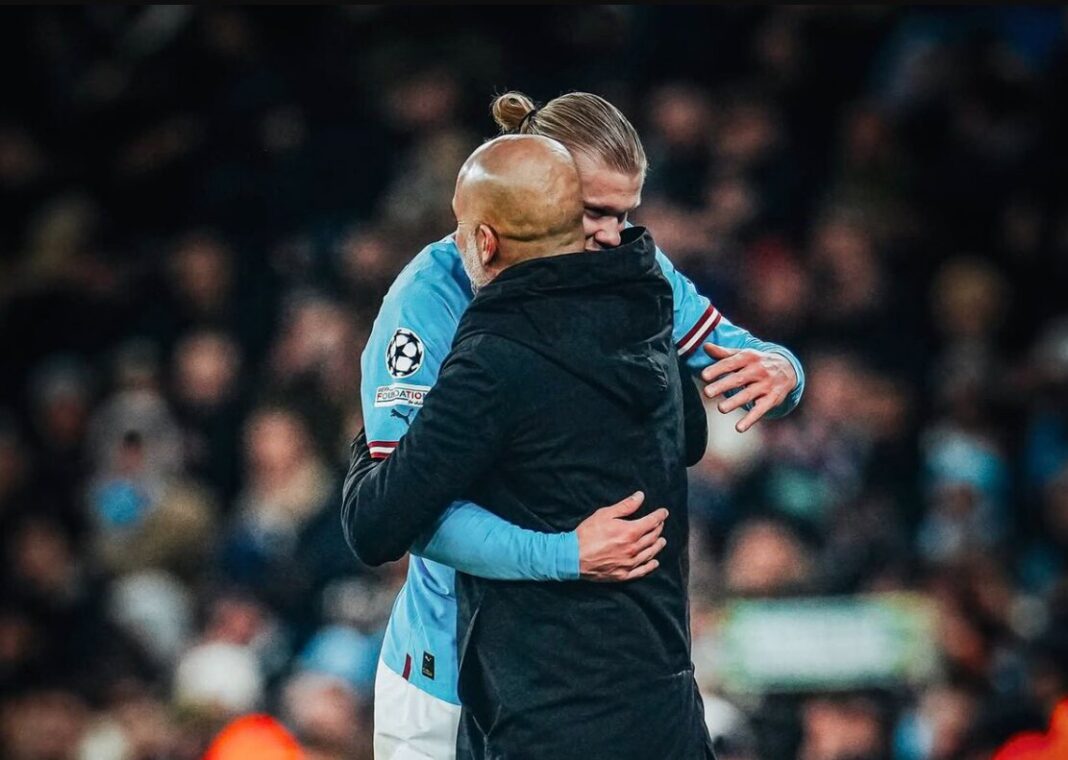
Erling Haaland arrived at Manchester City as a goalscoring machine already built for the biggest stages. Under Pep Guardiola, he became something even more dangerous: a striker shaped by obsession, detail, and the relentless pursuit of perfection.
Days after Guardiola’s 10-year Manchester City reign ended with a 2-1 defeat to Aston Villa, Haaland shared a touching message for the manager who changed both the club and the players inside it. The Norwegian striker described Guardiola as a coach who “never stopped teaching” and made greatness feel normal, a line that captured the emotional weight of the goodbye better than any trophy count could.
For City, Guardiola’s exit is not just the end of a managerial spell. It is the closing of the most successful chapter in the club’s history.
For Haaland, it is the farewell to the coach who helped turn his already frightening talent into part of a wider footballing machine.
Haaland’s Message Shows the Human Side of a Winning Machine
Guardiola’s Manchester City were often described through numbers: points totals, winning streaks, possession percentages, trophies, goals scored, records broken. But Haaland’s tribute reminded everyone that the Guardiola era was also built in the quiet spaces away from matchday.
Training ground details. Tactical corrections. Demands repeated again and again. Conversations about movement, pressing, body shape, timing, and decision-making.
That is what Haaland seemed to point toward when he said Guardiola “never stopped teaching.”
For a striker who joined City in 2022 already viewed as one of football’s most devastating finishers, that lesson matters. Haaland did not arrive needing to learn how to score. He arrived needing to learn how to fit into a team that treated every pass, every run, and every position as part of a larger structure.
That adjustment was not simple.
Guardiola’s football asks even the most natural attackers to think constantly. Haaland had to learn when to stay high, when to drop, when to pin centre-backs, when to delay runs, and when to sacrifice touches so others could thrive. The goals still came, but they came within a system that demanded more than instinct.
That is why the relationship became so important.
Guardiola did not blunt Haaland’s edge. He refined how that edge was used.
Guardiola Made Greatness Feel Normal
Haaland’s line about Guardiola making greatness feel normal may be the most accurate description of City’s last decade.
Under Guardiola, winning became routine without ever being easy. Premier League titles were chased with machine-like consistency. Domestic cups became another measure of depth. The Champions League, long the missing piece, finally arrived and gave the entire project its crowning validation.
Twenty major trophies. Six Premier League titles. One Champions League. A decade of dominance.
Those achievements are huge, but City’s real transformation came in expectation. Before Guardiola, trophies were dreams and ambitions. Under him, they became the standard. Every season began with the belief that City should compete for everything. Every dropped point felt dramatic because Guardiola had raised the bar so high.
That mentality shaped Haaland too.
The Norwegian did not just score goals in a successful team. He became part of a culture where scoring was never enough if the press was wrong, the movement was late, or the collective rhythm slipped. Guardiola’s genius was not only tactical. It was psychological. He convinced elite players that improvement never ended.
That is what Haaland is acknowledging.
Even greatness had homework.
The Aston Villa Defeat Could Not Rewrite the Era
Guardiola’s final match did not offer the fairytale ending City fans wanted.
A 2-1 loss to Aston Villa gave Unai Emery’s side the final word on the pitch, but not on the legacy. Football has a habit of denying perfect scripts, and Guardiola’s farewell was another reminder that even the best managers cannot control every ending.
Still, the defeat changes little.
The final score belongs to one afternoon. Guardiola’s legacy belongs to a decade.
City supporters will remember the title races, the Treble, the Champions League breakthrough, the tactical inventions, the impossible standards, and the players who reached new levels under his guidance. Haaland’s tribute fits into that memory because it shows what Guardiola meant inside the dressing room.
He was not simply the man selecting the team.
He was the teacher who kept pushing.
A Manager Who Transformed Club and Player
Haaland credited Guardiola’s relentless mentality with transforming Manchester City and himself. That word, “relentless,” sits at the heart of the Guardiola story.
There was always another detail to fix. Another pattern to sharpen. Another weakness to remove. Another trophy to chase. That hunger can be exhausting, but it is also why City became the defining English club of their era.
For Haaland, the transformation was personal.
He joined City as a superstar finisher. Under Guardiola, he became the focal point of a team that demanded total discipline from every player, even the one expected to deliver the final touch. His goal record showed his individual brilliance. His adaptation showed his growth.
That is the hidden achievement of Guardiola’s coaching.
He did not only create systems. He changed players’ understanding of the game.
City Enter a New Chapter Without Their Master Builder
Guardiola now steps into a global ambassador role with City Football Group while taking a break from coaching. That means he remains connected to the wider City project, but the touchline will no longer belong to him.
For Manchester City, that is the true emotional shift.
The gestures, the instructions, the intensity, the restless pacing, the tactical corrections after victories as much as defeats. Those images defined an era. Replacing the manager is one thing. Replacing that presence is something else entirely.
Haaland and the rest of City’s stars now become the bridge between eras. They carry the standards Guardiola built, even as a new voice prepares to lead them.
That may be Guardiola’s final gift to the club.
He leaves behind not only trophies, but habits.
Haaland’s Tribute Captures the Goodbye
There will be many tributes to Guardiola. Some will focus on numbers. Some will focus on tactics. Some will place him among the greatest managers football has ever seen.
Haaland’s message felt different because it came from inside the work.
A player who lived through Guardiola’s demands called him a coach who never stopped teaching. That is the line that will stay with City fans, because it explains why this era became so extraordinary.
Pep Guardiola made Manchester City great, then made greatness feel normal.
Now he leaves the touchline with 20 major trophies, a transformed club, and players like Haaland carrying the lessons forward.
The final match ended in defeat.
The era ends in history.

