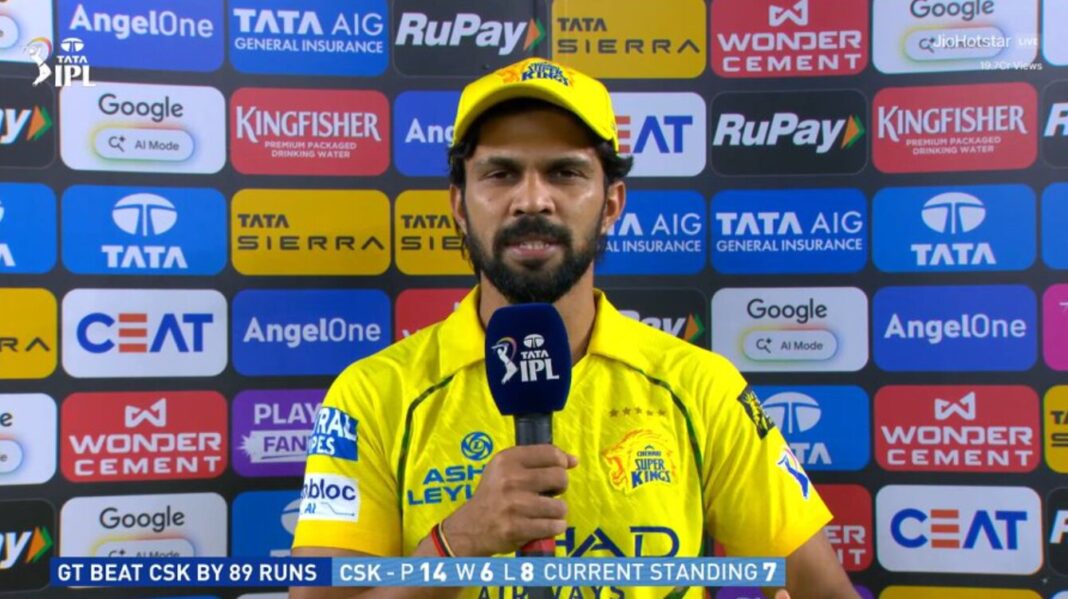
Chennai Super Kings did not just lose a match in Ahmedabad. They lost the final thread connecting them to the IPL 2026 playoffs.
Gujarat Titans delivered a brutal performance at home, piling up 229 for 4 before bowling Chennai out for 140 in just 13.4 overs. The 89-run defeat slammed the door shut on CSK’s campaign and left the five-time champions in seventh place with six wins from 14 matches.
For a franchise built on consistency, calmness, and late-season surges, this was a painful ending. Chennai have made a habit of staying alive when others count them out. They have turned impossible chases into folklore and slow starts into playoff pushes. But this season offered no such rescue act.
This time, the gap was too wide.
Gujarat played with the confidence of a side that knew exactly where the pressure points were. Their batting was aggressive, calculated, and relentless. Once they reached 229, Chennai needed something close to perfection with the bat. Instead, the chase fell apart quickly, leaving CSK’s season to end not with a fightback, but with a collapse.
Gujarat’s Batting Power Breaks Chennai’s Resistance
A target of 230 in a must-win situation does not only test batting quality. It tests nerve.
CSK’s bowlers were placed under pressure early, and Gujarat never allowed them to settle. In Ahmedabad, where momentum can shift quickly under lights, the Titans made sure they controlled the rhythm from the first phase of the contest.
Their total of 229 for 4 was not just big. It was psychologically damaging.
Chennai’s season had already been shaped by inconsistency, injuries, and uncertainty. Once Gujarat crossed 200, the match began to feel like a final examination of a team that had spent months searching for balance. CSK needed discipline at the death, clean execution, and a clear plan to stop the run flow.
They found none of it for long enough.
The Titans’ batting forced Chennai into reactive cricket. Fielders were pushed back. Bowlers missed lengths. The pressure moved from one over to the next, and by the time the innings ended, Gujarat had given themselves complete control of the match.
CSK’s Chase Never Truly Took Off
Chennai needed a fearless response. What they produced was a chase that never found shape.
Bowled out for 140 in 13.4 overs, CSK were not just beaten by scoreboard pressure. They were beaten by the weight of the moment. Chasing 230 requires clarity: one batter has to go deep, partnerships have to form quickly, and risk must be managed without losing aggression.
Instead, wickets damaged the chase before it could develop.
The required rate was always steep, but the greater issue was the absence of control. Once Gujarat struck regularly, Chennai were left chasing both runs and belief. The innings became a series of desperate attempts rather than a structured pursuit.
That has been the story of their season in many ways.
There were flashes of fight, but not enough consistency. There were individual efforts, but not enough collective momentum. There was spirit, as captain Ruturaj Gaikwad later pointed out, but spirit alone could not cover the wounds that kept reopening across the campaign.
Ruturaj Gaikwad’s Leadership Under Spotlight
Gaikwad finished IPL 2026 with 337 runs at a strike rate of 123. Those numbers tell part of the story, but not all of it.
As captain, he was carrying more than batting responsibility. He was leading CSK through one of the most delicate phases in franchise history: the post-Dhoni transition. That is not an ordinary assignment. Chennai are not simply replacing a player. They are moving out of an era shaped by one of cricket’s sharpest minds and most influential leaders.
After the defeat, Gaikwad praised his team’s spirit, a sign that the dressing room has not fractured despite a difficult season. That matters, even if the table does not show it. Teams in transition often collapse emotionally before they collapse tactically. CSK, for all their wounds, still appear to have belief inside the group.
But the cricket has to catch up.
Gaikwad’s own season was steady rather than explosive. A strike rate of 123 will invite debate, especially in a league where top-order intent has become increasingly important. Yet judging him only through runs would ignore the wider burden he carried. He was trying to build authority in a team still emotionally tied to Dhoni’s presence.
That shadow remains enormous.
Dhoni’s Possible 2027 Return Keeps Hope Alive
MS Dhoni missed the entire campaign because of injuries, and his absence was felt everywhere.
Not just behind the stumps. Not just in finishing roles. Not just in tactical calls. His absence changed the emotional architecture of CSK. For years, Chennai had the comfort of knowing that when chaos arrived, Dhoni would slow the game down. He could read pressure better than almost anyone. He gave the team a psychological edge even before he faced a ball.
Without him, CSK looked more human.
Gaikwad’s hint at a possible Dhoni return in 2027 will naturally stir hope among supporters. For fans, the idea of seeing the legend back in yellow carries emotional power. But it also raises a complicated question for the franchise.
How long can Chennai remain between two worlds?
They need to respect Dhoni’s legacy, but they also need to build beyond it. That balance is difficult. Move too quickly, and it feels like betrayal. Wait too long, and the next era struggles to breathe.
Fleming Backs Gaikwad Amid Transition Pain
Stephen Fleming’s backing of Gaikwad was significant.
Calling him his best captain after Dhoni was not a casual line. It was a public show of trust at a time when pressure could easily build around leadership. Fleming understands CSK’s culture better than anyone. He knows the standards. He also knows that replacing Dhoni’s influence cannot happen in one season.
His message was clear: patience is required.
That may not be easy for a fanbase used to success. Chennai supporters have watched title runs, playoff comebacks, and iconic finishes. Seventh place with six wins from 14 matches will feel unfamiliar and uncomfortable.
But transitions are rarely clean.
This season was marked by injuries, inconsistency, and emotional adjustment. The defeat to Gujarat exposed the distance CSK still have to travel, but it should not be treated as the full measure of Gaikwad’s leadership. A captain’s real test often comes after a season like this, when the noise gets louder and the rebuild becomes unavoidable.
What This Means for Chennai
CSK now face a major offseason.
They need more batting aggression, greater bowling control, and clarity over the future shape of the side. If Dhoni does return in 2027, the franchise must decide what role truly helps the team move forward. If he does not, they must give Gaikwad the space and support to fully own the next chapter.
Gujarat, meanwhile, showed what a settled and ruthless side can do when they smell vulnerability. Their performance was sharp, dominant, and playoff-worthy in attitude.
For Chennai, Ahmedabad became the final blow in a campaign full of warning signs.
The yellow shirts will return. They always do. But this version of CSK needs more than nostalgia and fighting spirit. It needs renewal, conviction, and a clear break from uncertainty.
The post-Dhoni era was never going to be painless.
Against Gujarat Titans, Chennai felt just how deep that pain can run.

